


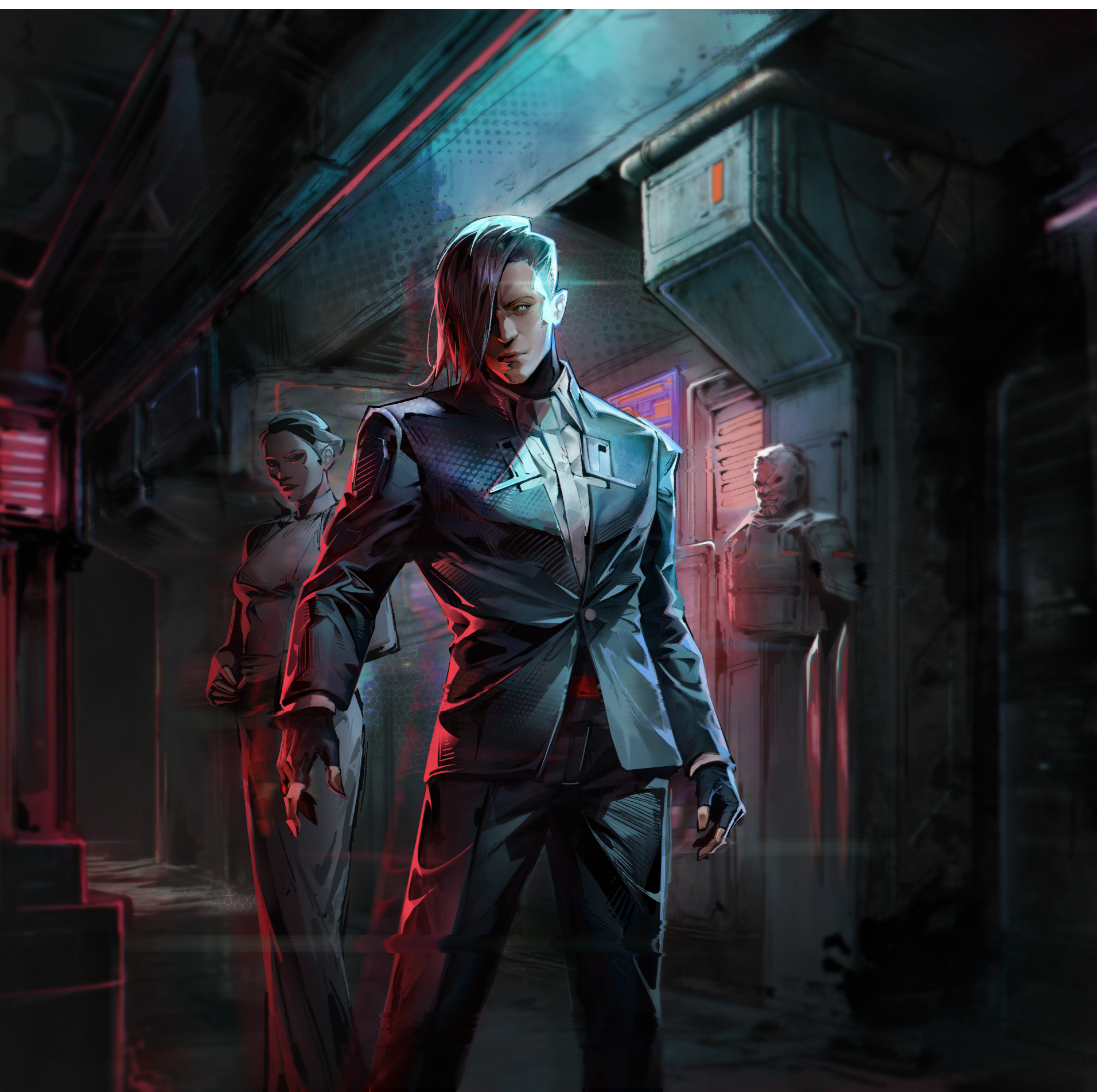
Whether it’s at a demo event, a prerelease, or your kitchen table, as soon as you get hands-on with Cyberpunk Trading Card Game you’re going to discover cards of four different colors: Red, Green, Blue, and Yellow.
If you’ve already played some games with one of our Alpha kits (or you’ve watched some of the content our amazing community has created using them) these colors will already be familiar. But what we haven’t told you just yet is exactly what makes one of our cards the color it is.
In this two-part article series we’re going to introduce you to the Color Tree — the guiding model that shapes the identity of every card in Cyberpunk TCG.
What is the Color Tree?
The Color Tree is a tool we use to consistently uphold the central themes of our game and define how each color interacts and behaves within it. It’s how we compartmentalize mechanics, not just to maintain game balance, but also to ensure players have diverse and distinct deck-building and gameplay options that resonate with them personally.
Imagine the Cyberpunk version of you standing in Night City. Whatever that character looks like, wherever their skills lie, and whatever motivates them, we want to make it as intuitive as possible to bring that expression of yourself to life in Cyberpunk TCG. The Color Tree helps us do that.
See yourself as a system saboteur that can hold their own in a bar fight? You’re probably Blue first, with a little Red thrown in for good measure. Or maybe you’re more of a tech-adept scavenger that’s chromed up to the max? If so, you’re pure Yellow.
Crucially, that doesn’t necessarily mean that a character like Lucy, who’s a highly skilled netrunner, will always be Blue for example. These colors enable us to express different aspects of each character’s personality. They’ll even help us show sides of your favorite Night City denizens that you haven’t seen before in other Cyberpunk media. We’ve got an incredibly deep and nuanced cast to work with, and we want to utilize every color to explore that depth in as many ways as possible.
So, what exactly makes this a tree?
Great question! Think of the central themes and elements of the game as our tree’s trunk. Low RAM evergreen mechanics sit close to the trunk. These are things like drawing cards, interacting with your opponent, and removing opposing threats. Each color expresses and accesses those mechanics in thematically unique ways, but they’re core capabilities that we want every color to have access to in at least one form.
As we move outward from the trunk, the branches representing each color become more distinct. Here we can introduce unique abilities and characteristics that are only available to that one color. Then, at the very tips of each branch, we have the highly flexible areas of fresh growth that give us the freedom to expand in different directions and find creative ways of expressing each color’s core identity through entirely new gameplay mechanics.
Much like a real tree, it’s both robust and organic. Stalwart, yet able to grow and evolve. But the color tree also bears some striking similarities to a skill tree from a video game. Let’s say, Cyberpunk 2077 for example…
The colors’ connection to attributes in Cyberpunk 2077
The colors in Cyberpunk TCG aren’t directly representative of attributes from Cyberpunk 2077. But they take heavy inspiration from them.
For players arriving from the video game, Red cards will feel reminiscent of the Body attribute. Blue has traits inspired by Intelligence. Green has parallels with Reflexes. And Yellow sits closest to Technical Ability.
That inspiration and influence is of course conveyed through card art and narrative storytelling. But they’re also expressed through the diverse ways that each color:
- Values and manipulates friendly Gigs
- Interacts with opposing Gigs
- Prioritizes Street Cred
- Manages and removes opposing threats
To give you a feel for how we achieve that, let’s take a look at the traits of Red and Green, along with some never-before-seen examples!
Red: Maximize, amass, overpower
Red is the color of maximization. Where other colors seek to outwit, outmaneuver, or disable opposing units, Red prefers to take its fights head-on and win through sheer power, resilience, and direct destruction.
As you might expect, that means Red cards often want your Gig values to be as high as possible, encouraging players to roll in high-potential dice like their d10 and d12 earlier in the game. If you roll low, that’s not a problem. Red will also help you manipulate Gig values upward by large amounts, or just steal high-value Gigs from your rivals. Go big, smash, grab, then go home.

Royce: Don’t Call Me Simon showcases a few of Red’s key characteristics at once. His Play effect directly defeats a low power unit, he rewards you for having higher Street Cred than your rival, and after all that is said and done, Simon — sorry, err, Royce — himself is a respectably-statted unit.

The same themes are expressed slightly differently through Carnage at the Colosseum. This high-impact Braindance costs less to play for each friendly Gig with a value of 8 or greater, and grows in flexibility based on your highest-power Unit. So, if you control the highest-power Unit in play, you can defeat absolutely any unit of your choice. The bigger you go, the more doors open for you.
Green: Align, gather, execute
Green’s core logic is all about alignment. It wants to form pairs of Gigs with the same value number, match Gig values with unit power, and maintain either odd or even Street Cred — and it isn’t afraid to steal and manipulate to get the numbers it needs. Remind you of any megacorps?
Often, that alignment is expressed through themes of family, community, and strength in numbers. Green rewards you for assembling groups of characters or more units than your rival. It also cares deeply about its legends — an indicator of respect for elders, superiors, and highly accomplished associates — and likes to call them earlier than other colors in many scenarios.
Drawing inspiration from the Reflexes attribute, Green is also characterized by speed. It likes to spend rival units to open them up to attacks, directly defeat spent units, and attack immediately. This enables it to be highly aggressive or calculated and precise. Once conditions are perfectly aligned, how you strike is up to you.

Sandayu Oda: Hanako’s Guardian perfectly exemplifies how Green uses alignment to overcome its rivals. For each friendly value-pair of Gigs, Oda enables you to spend a rival unit, leaving them vulnerable to attack. Pair that with his ability to attack immediately, and you can neutralize (almost) any threat on sight. Very fitting for Hanako Arasaka’s personal bodyguard.

Alignment rarely happens naturally or by chance. It’s something that’s achieved through diligent planning, and maybe a little bit of disruptive intervention. Peace Offering simultaneously helps Green players make Gig value-pairs and rewards them for doing so. A perfect harmony.
That’s all for now! Check back soon for part two where we’ll round the tree out with a look at Blue and Yellow.