


In the first installment of this two-part article series we introduced you to the Color Tree, its purpose, and some of the initial traits associated with Red and Green cards that you’ll find in our first set, Welcome to Night City. If you missed that, you can get up to speed here.
Now, let’s do the same for the two remaining colors, Blue and Yellow.
Blue: Minimize, hack, disable
Where Red wants to maximize, Blue is more concerned with minimization. Blue doesn’t make a lot of noise and stays under the radar by favoring low Street Cred, rolling smaller dice first, and actively reducing its Gig values down to their minimum. Whether you’re underestimated or completely unseen, both create opportunities for a rapid takedown.
Blue has a deep connection to netrunning, expressed through synergies with programs and braindances. It utilizes both to impose its minimalist preferences onto its rivals, bringing their power down to size or disabling them altogether.

Maman Brigitte: Spirit of Death tells us a lot about Blue’s core identity. Her Play effect carries a high cost. You’ll need to discard two programs if you want to use it, which right away speaks to Blue’s above-average proclivity for programs, and gently suggests that the color may have ways to return or play them from your trash later. Sometimes less really can be more.
If you can pay the cost, the reward is huge. Bottom-decking a rival unit is one of the most permanent methods of threat removal in the game. Some colors have efficient ways to return units from their trash, but it’s a very long road back from the bottom of a deck. It’s like they were never even there.

Speaking of programs, Chrome Reverie shows off just one of the ways that Blue can temporarily disable rival units, in this case, preventing them from attacking. There’s also a big payoff on offer if you control a min Gig. This combination of short-term disruption and Gig value minimization, both enabled by a single program, is distinctly Blue.
Yellow: Diverge, equip, repurpose
Standing in stark contrast to Green, Yellow is all about Divergence. It makes small, precise up and down adjustments to its Gig values to ensure each is unique, and that its Street Cred is as different as possible from its rival’s.
Every color has access to gear, but Yellow specializes in it. Yellow utilizes gear in unique and creative ways that the other colors can’t. Occasionally, that overlaps with Yellow’s subthemes of sacrifice, where it happily destroys its own resources to remove its rivals’, and scavenging, where sacrificed resources are recovered for reuse.

There’s more than one way to use gear to overcome your rivals, provided that you’re willing to get a little creative of course. Gilded Matón shows how Yellow’s ingenuity extends far beyond simply building and equipping powerful new chrome. With a little extra tech know-how, anything can be repurposed to flatline the opposition.

If you’re going to defeat one of your own pieces of gear with Gilded Matón, you’ll need to pick the right moment. Ideally, when that gear has already served its purpose and provided a good return on the Eddies you invested into it.
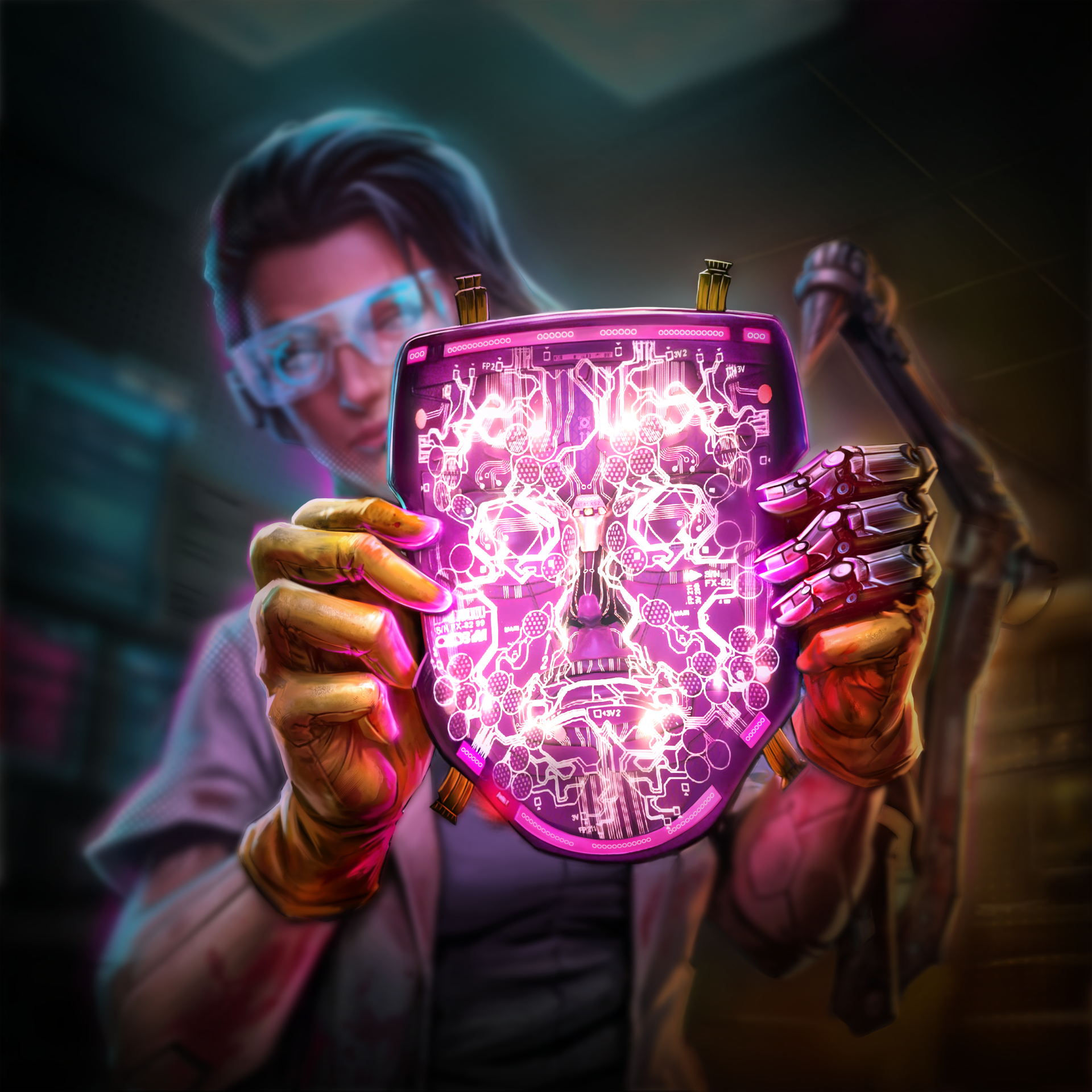
Zetatech Faceplate can make that choice a little bit tricky, in the best kind of way. It enables you to manipulate your Gigs to create the divergence Yellow thrives on every single time the unit or Legend it’s equipped to is spent. Once you’ve gathered three Gigs of different values, it’ll also draw you a card each time that happens. So, when it comes to cashing it in to remove a rival threat, there’s only one real question to answer: how greedy are ya feelin’ today choom?
How all four colors stack up
So, to zoom back out for a moment, here’s a simple summary of each color’s initial identity:

That’s all… for now
We hope you’ve enjoyed that brief introduction to the colors in Cyberpunk TCG and the model that guides how we design cards for each of them.
As we mentioned in Part 1, one of the big reasons why we like the tree analogy so much is that it provides a solid foundation for the game, while giving us room to grow. What we’ve covered here is just the first expression of each color. By no means are those the limits of what each color will eventually be able to do.
If you’ve played with some of our Alpha kit cards, that should already be apparent. If you’re wondering why some of the cards there don’t perfectly align with the characteristics we’ve outlined here, it’s because they played an important role in helping us define exactly what we want the first expression of each color to look and feel like.
Now you’ve got a good indication of what to expect in Set 1: Welcome to Night City. We’re not quite ready to talk about what’s next for each of these colors, but it’s safe to say that we’re incredibly excited to share some of the cool ways our Color Tree is going to grow in the future.